By Denise Ferris
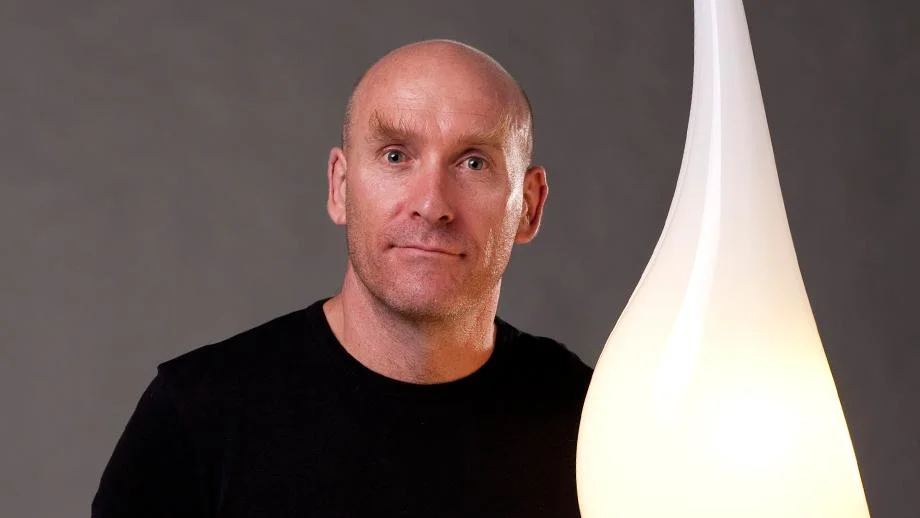
Robbie Foster is an alumnus of the School of Art at the Australian National University. He graduated with a Bachelor of Arts (Visual) in 1985, and then completed a Graduate Diploma in Art (Visual) in 1986. Rob trained in traditional silversmithing at the ANU School of Art. His current status as a renowned designer /maker and entrepreneur was nurtured by Ragnar Hansen, and in post-graduate courses, Johannes Kuhnen. These two divergent European traditions – the organic Scandinavian [Hansen] and the reductive Becker aesthetic [Kuhnen] – came together in an Australian teaching institution that continues to be unique to the ANU.
Rob used hand-raising techniques, explosive technologies, bush mechanic ways and anything he thought would work but all of this crystallised into a refined exquisite outcome.
He was a friend to so many, a strong presence, connected with so many staff and students across a range of disciplines at the school. Last year the School of Art nominated Rob for an ANU Alumni Award, the inaugural Award for Innovation and Entrepreneurship. In a case drafted by his friends and colleagues Barb McConchie and Rohan Nicol the nomination responded to diverse categories that effortlessly showcased Rob’s gifts, his initiatives and his achievements. One category read:
Evidence of research, development and prototyping of an innovation opportunity that will create value and benefit to society.
That response was easy, referring to Rob’s genius with materials and constant flow of ideas. The case was so straightforward to write, and the background, which named the Victorian Albert Museum in London, the Museum of Modern Art in New York and the Museum fur Kunst und Gewerbe in Hamburg as destinations for his original thinking and creative inventions. The School of Art’s case described Rob’s Breakthrough moment, the Fink jug, his entrepreneurship and his continuing innovation.
From a university wide field Rob received the alumni award at a ceremony and dinner, which was attended by luminaries gathered to honour the brightest and highest achieving graduates from ANU.
When Rob stood up to speak he said,“The in-depth teaching that I received at the ANU School of Art, alongside the encouragement to explore ideas, ultimately resulted in what I have achieved through F!NK + Co and has inspired many other budding and successful creatives.”
Rob went to those awards but only learnt he would be speaking just before the award ceremony. Up until the award dinner, in true Rob Foster style, he had been arm deep in an anodising bath creating a ceremonial mace for an unnamed university. His transition from workshop maker to suited speaker was seamless.
Developing his natural inquisition as an engineer Rob became a sophisticated designer. He leaves, for current and future students, his demonstrated practice, which served as a laboratory, identifying questions and evaluating possible solutions.
His methods deeply rooted in craft traditions provide a valuable model for future generations. Those designer makers will have the benefit of the demonstrated value of a highly developed sense of aesthetics and technical proficiency.
His faculty to commercialise design solutions marked him as a unique innovator, serving as a shining exemplar of how those trained in the humanities arts and social sciences, make important contributions to Australia’s culture of innovation.
Rob guest lectured at the School of Art, worked as a technician, and generously contributed to the teaching within the Gold & Silversmithing department- naturally making his impact on multiple areas of the school. An administrator mentioned to me recently that she remembered Rob, and added “and when he had hair!”
He has employed and provided internships, mentoring and work experience to over 25 ANU students, and six ANU graduates have designed products for the F!NK range. He epitomises a generation of Australian makers who generated work for a global audience and he generated this work from the region, Queanbeyan, London, New York, Hamburg.
The ANU and the School of Art community mourn Rob’s loss. In time we will find ways to ensure his singular contribution continues to be publically acknowledged. Meanwhile as friends, colleagues and simply human beings in any community – what can we take from this sadness? Perhaps this: to value that community, our community, and that as human beings, makers, artists and designers, we must honour one another, that we must recognise each other’s struggles as well as acknowledge and value our successes. Rob would want that.